Back
Back










 BACK TO BLOG HOME
Running one restaurant is tough. Managing five, ten, or fifty? That’s a whole new level of chaos.
Every outlet has its own team, customers, and challenges, but your brand experience needs to feel seamless no matter where a guest walks in. That’s where a CRM (Customer Relationship Management) system comes in.
Think of CRM as your control centre. It brings together guest data, loyalty programs, feedback, and campaigns, all under one dashboard. For growing restaurant chains, it’s not just helpful. It’s mission-critical.
Here’s how a good CRM becomes the secret ingredient behind smooth operations, happy guests, and consistent growth.
First, What Exactly Is a Restaurant CRM?
A restaurant CRM is a digital system that helps you collect, store, and use customer data, like visit history, order preferences, feedback, and more, to build stronger relationships with your guests.
Think of it like a memory bank. Except it doesn’t forget.
It’s different from your POS (Point of Sale). While POS systems are great for transactions and billing, CRMs are built to nurture relationships and, ultimately, loyalty. Read more about the same
Why Multi-Location Chains Need CRM More Than Ever?
When you’re running a single location, you might still get away with remembering faces or using manual systems. But with five, ten, or fifty outlets? You need smart systems that talk to each other and learn from each customer interaction.
Here’s how CRM helps at every level:
1. Unifying Customer Data Across Locations
Imagine a guest who dines in your Mumbai outlet one weekend and visits your Delhi branch the next. With CRM, your staff already knows their food preferences, allergy notes, birthday, and past orders.
Magic? Nope, just data.
CRM creates centralized customer profiles that are accessible across every outlet. This means:
- Personalized service, regardless of location
- Faster ordering and better upselling
Familiar experiences that make guests feel truly known
Ohh you must also watch out for these 7 Common Restaurant CRM Mistakes 👇
2. Building Loyalty That Sticks, No Matter Where Customers Dine
A CRM lets you set up a chain-wide loyalty program that works seamlessly across locations.
Whether someone earns points in Hyderabad and redeems them in Pune, their loyalty journey continues. And the best part? You can surprise and delight your top guests with offers tailored to them, like a special dessert for someone who’s visited five times in a month.
Loyalty becomes less about “earn-and-burn” and more about emotional connection.
3. Smarter Marketing, Made Personal
Good marketing isn’t about blasting offers to everyone. It’s about talking to the right people with the right message at the right time.
With CRM, you can:
- Segment customers by behavior, spend, visit frequency, or location
- Send birthday wishes, win-back campaigns, or special weekday deals
- Personalize every message to make it feel like a one-on-one conversation
And since all your data is in one place, your campaigns stay consistent across platforms and outlets.
No more guesswork. Just results.
4. Unlocking Customer Insights That Actually Drive Growth
You don’t need more reports. You need meaningful insights.
A powerful CRM shows you:

- Who your top spenders are
- What time people visit the most
- Which dishes are killing it and which ones are collecting dust
- What kind of offers drive repeat visits
You can even track feedback trends and address issues before they snowball.
Bottom line: CRM takes you from “we think” to “we know.”
5. Gaining a 360° View of Your Business
With CRM, you’re not just looking at one store in isolation. You’re seeing the entire business at a glance.
From customer behavior and campaign performance to outlet-wise revenue and visit patterns, you get a clear, real-time view that helps you make smarter, faster decisions.
Whether you’re tweaking a menu, planning expansion, or training staff, you’re backed by data that tells you what’s working and what needs fixing.
6. Making Operations Smoother and More Standardized
A good CRM goes beyond just marketing. It touches every part of your business:
- Inventory forecasting: Know which ingredients are moving fast based on real guest demand.
- Menu engineering: Spot underperforming dishes and rotate in new crowd-pleasers.
- Staff performance: Track service quality and customer feedback by outlet or team.
- Training consistency: Ensure every outlet delivers the same guest experience using CRM-driven insights and SOPs.
It’s like having an operational playbook built into your system.
Real Results: How Reelo Helps Multi-Location Chains Like Jumbo King
Let’s talk about scale.
Jumbo King, one of India’s biggest homegrown QSR brands, runs 165+ outlets across the country. They use Reelo to centralize customer data, run unified loyalty programs, and manage marketing, all from a single dashboard.
With Reelo:
- Customers get a seamless loyalty experience across every outlet
- The marketing team launches targeted campaigns using segmented data
- Store managers get insights on customer preferences and visit frequency
- Headquarters ensures brand consistency and tracks outlet performance in real-time
Reelo isn’t just a CRM. It’s an all-in-one solution built for growing restaurant chains that want to deliver delight at scale.
Whether you have 3 locations or 300, Reelo makes it easy to:
- Consolidate guest data across locations
- Run smarter loyalty programs
- Launch hyper-targeted campaigns
- Collect and act on feedback instantly
- Train teams using a centralized platform
If you’re a growing restaurant brand looking to bring your customer experience and marketing under one roof, Reelo’s got your back.
Frequently Asked Questions: Multi-Location Restaurant CRM
Ques . 1. How do multi-location restaurant owners customize CRM solutions?
Start by identifying your most valuable customer data. Focus on visit frequency, favorite dishes, spending patterns, and customer feedback. These data points help create meaningful customer segments.
Most CRM systems offer extensive customization options. You can customize dashboards to display location-specific metrics. Automate workflows for different customer segments. Create targeted campaigns based on customer behavior.
Tailor your messaging for different location types. Urban customers often have different preferences than suburban diners. Set up different loyalty program tiers based on individual outlet performance. This approach helps maximize engagement at each location.
Ensure your CRM supports role-based access controls. Staff should see data relevant to their location and responsibilities. Meanwhile, headquarters needs complete visibility across all outlets for strategic decision-making.
Ques. 2. What are the best CRM features for managing multiple restaurant locations?
Look for these essential features when choosing a multi-location restaurant CRM:
Centralized guest profiles track customer interactions across all your locations. When customers visit any restaurant, staff can access their complete history and preferences instantly.
Multi-location loyalty tracking allows seamless reward earning and redemption. Customers enjoy consistent experiences regardless of which location they visit.
Geo-targeted campaign tools enable location-specific marketing. Send targeted offers based on customer proximity, local events, or seasonal preferences.
Real-time analytics and dashboards provide instant performance insights. Monitor sales, customer satisfaction, and staff performance across all locations simultaneously.
Staff performance insights help identify top performers and training opportunities. This feature supports consistent service quality across your restaurant network.
Integration capabilities with POS systems, inventory management, and feedback platforms create seamless operations. Connected systems eliminate data silos and improve efficiency.
Choose a CRM that maintains brand consistency while allowing local-level customization. This balance ensures unified customer experiences with location-specific flexibility.
Ques. 3. Should you use centralized vs. localized CRM strategies?
The most effective approach combines both centralized and localized strategies. This hybrid model offers the best of both worlds.
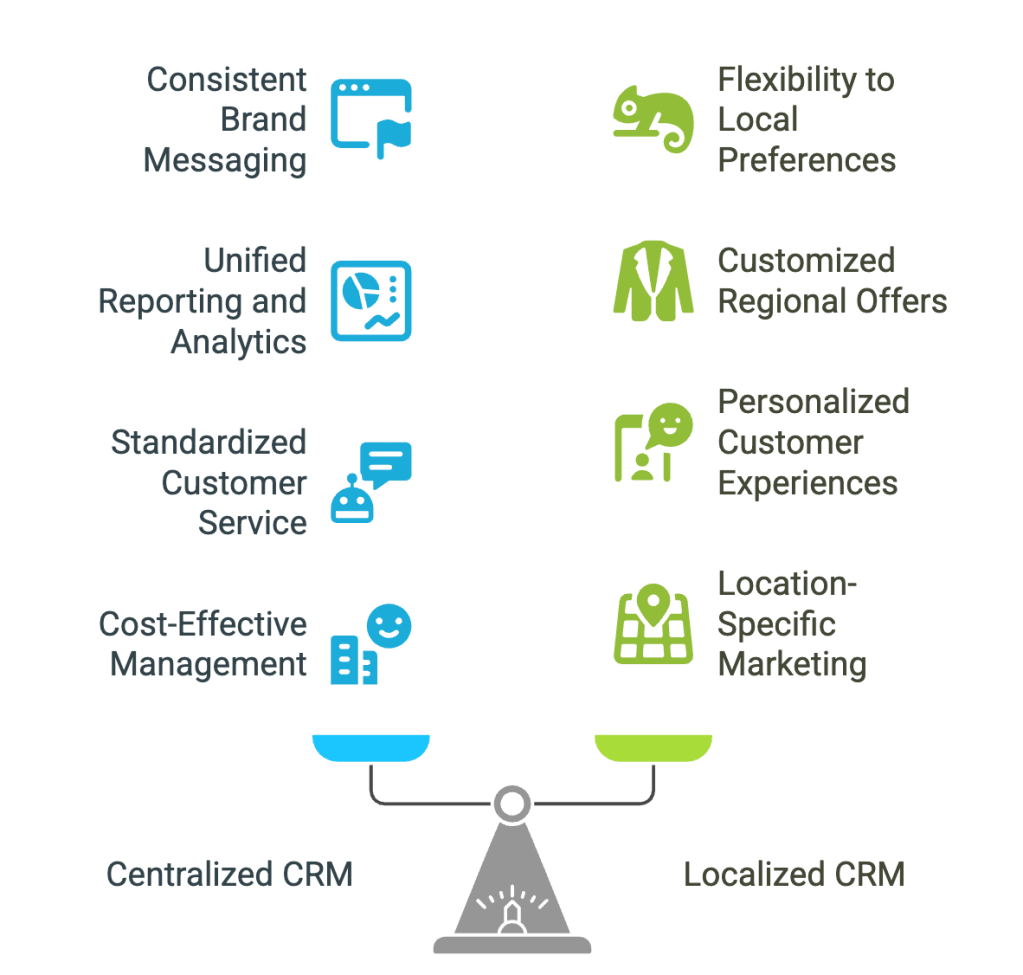
The hybrid approach works best. Centralize core customer data, brand standards, and major promotional campaigns. Allow local teams to customize offers, events, and promotions based on their market knowledge.
Major restaurant brands like Starbucks and McDonald’s succeed with this model. They maintain consistent brand experiences while adapting to local preferences and market conditions.
Ques. 4. How do you measure CRM success across multiple restaurant locations?
Success metrics should align with your business objectives while accounting for location-specific factors. Track these key performance indicators:
Customer retention rates by location show how well each restaurant maintains relationships. Compare rates across locations to identify best practices and areas needing improvement.
Average order value trends indicate whether your CRM strategies increase spending. Track changes over time and compare performance between locations with different approaches.
Loyalty program engagement rates measure how actively customers participate in your rewards program. High engagement typically correlates with increased visit frequency and spending.
Staff adoption rates show how consistently your team uses the CRM system. Low adoption at specific locations may indicate training needs or system usability issues.
Campaign response rates measure the effectiveness of your marketing efforts. Compare performance across different locations and customer segments to optimize future campaigns.
Cross-location visit frequency tracks customers who visit multiple restaurant locations. This metric indicates brand loyalty and the effectiveness of your unified customer experience.
Regular reporting helps identify successful strategies for replication across other locations. It also highlights areas needing improvement before they impact customer satisfaction or business performance.
Final Thoughts
CRM is not just a fancy tech tool. For multi-location restaurant chains, it’s the engine that powers growth, loyalty, and consistency.
It gives you a single source of truth about your customers, helps you treat them better, and makes sure every outlet delivers your brand promise.
So if you’re still juggling Excel sheets and WhatsApp groups to track feedback, loyalty, or promotions, it’s time to move forward.
CRM is no longer optional. It’s essential.
Ready to get started? Explore how Reelo can help you simplify your restaurant marketing, loyalty, and operations. Because in the business of food, consistency and customer love always win.
About The Author