

Running a restaurant is like running a theatre. The stage (your dining area) must always be presentable, the crew (your staff) in sync, and the audience (your customers) delighted every single time. Now imagine trying to run this entire show blindfolded, no idea who your regulars are, what your audience loves, or when the next performance should be. That’s exactly what happens when you rely on generic CRM tools that weren’t made for the food business.
While a generic CRM might help a car dealership or a SaaS company close leads, it just doesn’t cut it for a restaurant. You need something that thinks like a restaurant owner, fast, intuitive, guest-focused, and repeat-driven.
That’s where a CRM for restaurants shines. Let’s break down exactly why it’s no longer a luxury but a necessity for growth.
What is a CRM for Restaurants?
A CRM, or Customer Relationship Management system, helps businesses track, manage, and act on customer data. Traditional CRMs like Salesforce or HubSpot are built for B2B businesses managing leads, deals, and long sales cycles.
A restaurant CRM is different. It is built specifically for F&B businesses where the goal is not to close a deal but to bring a guest back again and again. It connects with your POS, collects data from every visit, and automates the marketing that turns one-time visitors into regulars.
In short: a generic CRM manages contacts. A restaurant CRM builds repeat business.
Restaurant CRM vs. Generic CRM: The Fundamental Differences
Here’s how CRM for restaurants differ (and outshine) generic CRMs:

Guest Data Collection: A restaurant CRM captures data from every dine-in, takeaway, and delivery order including visit frequency, spend, and menu preferences. A generic CRM stores contact details but has no connection to your billing or orders.
Loyalty and Rewards: A restaurant CRM runs automated loyalty programs that reward repeat visits and win back lapsed customers. Generic CRMs may support email lists but have no loyalty logic built in.
Feedback Collection: Restaurant CRMs trigger post-visit feedback requests via WhatsApp or SMS automatically. Generic CRMs have no mechanism for this.
POS Integration: Restaurant CRMs connect directly with billing systems like Petpooja, so every transaction is linked to a customer profile. Generic CRMs cannot do this out of the box.
Marketing Automation: Restaurant CRMs segment customers by behavior, spend, visit time, and order channel, then send personalised campaigns automatically. Generic CRMs offer basic email campaigns with no restaurant-specific logic.
Reservation and Walk-in Management: Restaurant CRMs help manage seating, reduce no-shows, and keep front-of-house operations smooth. This is simply outside the scope of a generic CRM.
The Silent Goldmine: Customer Data
Let’s get real, your customer data is your most underutilized asset.

Every bill, every visit, every order tells a story. Without a restaurant CRM, that data sits locked inside your POS or disappears entirely.
With the right CRM in place, here is what becomes possible:
- Rich customer profiles: Every guest gets a complete record including name, contact, visit frequency, average spend, order history, and feedback received, all in one place.
- Identify your best customers: See your top spenders and most frequent visitors clearly, and market to them differently from first-time guests.
- Win back lapsed customers: Automatically identify guests who have not returned in 30, 60, or 90 days and trigger a personalised offer to bring them back.
- Smarter segmentation: Group customers by location, time of visit, cuisine preferences, or order channel, and send campaigns that are actually relevant to each group.
None of this is possible with spreadsheets or a generic CRM.
What Marketing Automation Looks Like With a CRM for Restaurant

Once your customer data is centralised, your CRM does the heavy lifting:
- Auto Campaigns: The CRM identifies customer behaviour, for example a guest who has not visited in 45 days, and automatically sends them a personalised coupon. No manual intervention needed.
- Event-Based Messaging: Automatically wish customers on birthdays and anniversaries with a special offer attached. These messages consistently drive one of the highest conversion rates of any campaign type.
- Behaviour-Based Segmentation: Send late-night happy hour messages only to guests who visit after 9 PM. Send weekday lunch offers only to office-goers who visit between Monday and Friday. Your campaigns reach the right people at the right time.
- WhatsApp, SMS, and Email Integration: Run campaigns across all three channels from one place. Use carousels, feedback forms, and loyalty updates without switching tools.
A restaurant CRM does not just store your data. It activates it.
Unique Operational Challenges That Only Restaurant CRMs Solve
Here are a few things restaurant owners often don’t realize they need CRM for, but absolutely do:
Reducing Staff Dependency: When a staff member leaves, they take their knowledge of regulars with them. A CRM ensures all customer data stays with your business, so service quality stays consistent regardless of team changes.
Cross-Location Loyalty: For multi-outlet brands, a restaurant CRM lets customers earn and redeem loyalty points across all locations. This builds loyalty to your brand, not just to one outlet.
Slow Day Boosters: If Tuesday afternoons are consistently slow, your CRM can identify customers who are likely to visit and send them a limited-time offer timed specifically for that window.
Recovering Lost Customers: The CRM tracks guests who have stopped visiting and re-engages them automatically with a targeted offer or a feedback request, without you having to lift a finger.
Building a Brand Memory: Knowing a regular’s favourite dish or dietary restriction makes your restaurant memorable. Your CRM stores this information and surfaces it so your team can act on it.
Generic CRM might still work, but at a cost
Generic CRMs are not entirely useless. But they aren’t built for the restaurant industry. And that’s where the problem lies.
Here’s how it starts: you pick a generic CRM for your restaurant. It does what it promises: stores customer data, helps you send campaigns, and shows campaign results. But soon, you find yourself going back and forth to track how many customers actually revisited or how much revenue your campaign brought in. You feel stuck.
This loop doesn’t break until you switch to a restaurant CRM that’s built to handle this kind of complexity.
Key Features You Can’t Afford to Miss
A powerful restaurant CRM should offer:
- Automated Loyalty Programs
- Customer Feedback Collection & Analysis
- Customer Segmentation by Behavior
- Marketing Automation Across WhatsApp, SMS, Email
- POS & Billing Integration
- Staff Performance Tracking Based on Customer Ratings
- Dashboard with Actionable Insights (Not Just Reports)
Restaurant CRM vs. POS: Same Kitchen, Different Ingredients
Many restaurant owners confuse their POS system with a CRM. But they serve different purposes. Your POS handles orders. Your CRM builds relationships.
That’s why choosing the right kind of CRM — not a generic one — makes a huge difference.
In short:
- POS tells you what was ordered.
- CRM tells you who ordered it, how often, and how to bring them back.
POS keeps your business running.
CRM keeps it growing.
Don’t confuse the two; they work best as a team, but only when you know what each one brings to the table.
Which CRM Should You Choose?
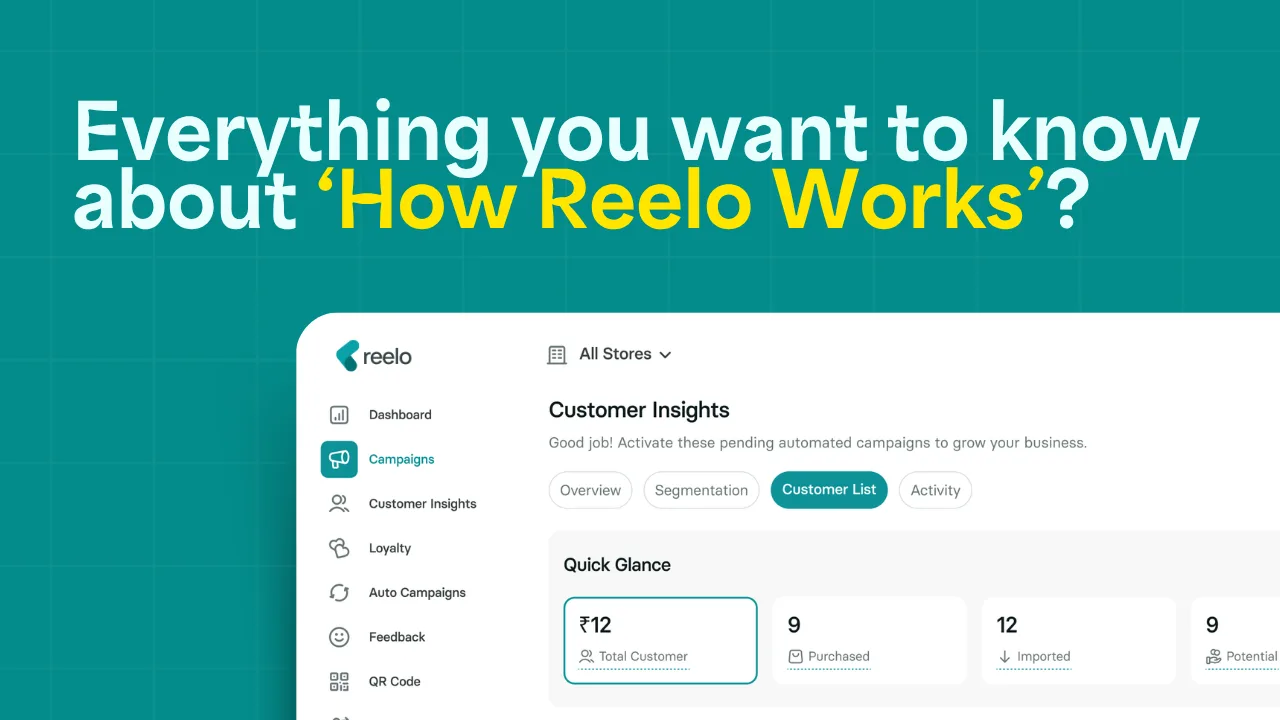
While there are many tools in the market, Reelo stands out as a CRM made only for restaurants. It’s not an afterthought or a generic tool retrofitted for F&B. Reelo was built ground-up to help restaurant owners solve real, day-to-day challenges.
Here’s what makes Reelo different:
- Deep POS Integrations with systems like Petpooja and over 35+ others.
- Automated Loyalty Engine that works for single and multi-outlet brands.
- Smart Feedback Workflows to reduce negative reviews and collect genuine responses.
- Hyper-Personalized Campaigns sent on autopilot.
- Intuitive Dashboard that gives you actionable customer insights in seconds — not hours.
- Affordable Pricing tailored for restaurants of all sizes.
Reelo is already trusted by 28000+ restaurant brands, proving that smart CRM drives real repeat business.
Questions You Might Be Asking
- Do I really need a CRM if I already have a POS?
Yes. Your POS records what was ordered and how much was paid. A restaurant CRM goes further: it tracks who the customer is, how often they visit, what they prefer, and triggers automated campaigns to bring them back. The two tools serve different purposes and work best together.
- What makes Reelo better than other CRMs for restaurants?
Reelo is built exclusively for restaurants. Every feature, from loyalty automation to feedback workflows to POS integration, is designed around how restaurants actually operate. It is not a generic tool adapted for F&B. It was built for F&B from the ground up.
- Is a restaurant CRM too complicated for a small team?
No. A good restaurant CRM like Reelo is plug-and-play. Most restaurant owners are up and running within a day, with no technical training required. The automations run in the background so your team does not need to manage them manually.
- Will a CRM help me get more customers?
A restaurant CRM focuses on bringing back the customers you already have, which is significantly cheaper than acquiring new ones. By improving guest experience, running personalised offers, and automating win-back campaigns, it turns one-time visitors into regulars.
- What is the best CRM for small restaurants in India?
Reelo is purpose-built for the Indian F&B market. It integrates with POS systems like Petpooja, supports WhatsApp marketing natively, and is priced to work for restaurants of all sizes, from single-outlet cafes to multi-location chains.
- How does a restaurant CRM integrate with Petpooja?
Reelo connects directly with Petpooja so every bill raised is automatically linked to a customer profile. This means your loyalty program, feedback requests, and campaigns all run off real transaction data without any manual input from your team.
Final Thoughts: Generic Isn’t Good Enough Anymore
Running a restaurant isn’t the same as running a software company, a car dealership, or a salon, so why settle for a CRM that was built for them?
A restaurant-specific CRM like Reelo helps you collect rich customer data, build automated loyalty programs, run personalized campaigns, and bring guests back, all without lifting a finger. It understands the daily grind of restaurant life and is designed to solve exactly those challenges.
So if you’ve been relying on spreadsheets, disconnected tools, or generic CRMs that just don’t “get” your business, now’s the time to upgrade.
Reelo is purpose-built for restaurants. It doesn’t just manage customers, it helps you grow with them.
Choose Reelo. Choose repeat business. Schedule a demo now!