



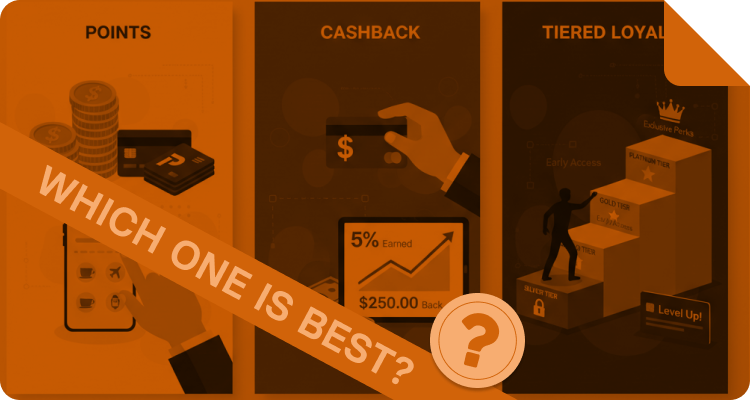
So among different loyalty program types. Points work best if you want a flexible, familiar system that fits most restaurants. Cashback works best if you want fast sign-ups and instant value. Tiered loyalty works best if you want long-term retention and repeat visits from your top customers. Most restaurants that scale end up combining two of these models instead of picking just one.
This guide breaks down how each model works, where it fits, and how to decide which one matches your restaurant’s goals.
What are points, cashback, and tiered loyalty programs?
These are the three most common loyalty models used by restaurants and F&B brands today.

Points programs give customers loyalty currency for every purchase. Customers collect points over time and redeem them later for free items, discounts, or rewards.
Cashback programs give customers a percentage of their bill back, either as wallet credit or a direct discount on their next visit. The value shows up almost immediately.
Tiered loyalty programs reward customers based on how much they spend or how often they visit. As customers move up tiers, they unlock better perks like free delivery, priority reservations, or exclusive menu access.
Each model solves a different problem. Points build habit. Cashback drives quick action. Tiers build status and long-term stickiness. The right one for your restaurant depends on your purchase frequency, your average order value, and what you want customers to feel when they come back.
How each loyalty model works
| Model | How it works | Value timing | Customer effort |
| Points | Earn currency per purchase, redeem later | Delayed | Medium |
| Cashback | Get money back after purchase | Immediate | Low |
| Tiered | Unlock perks as spend or visits increase | Long-term | Low to medium |
Points systems ask customers to think ahead. They earn now and cash in later, which works well for restaurants with regular repeat visits like cafes, QSRs, and casual dining chains.
Cashback systems remove the wait. Customers see the value the moment they get it, which makes the program easy to explain and easy to trust.
Tiered systems play a longer game. They reward loyalty over months, not single visits, and they work best when customers already visit often enough to notice the climb.
Points loyalty explained
Points loyalty is the most widely used model in restaurants because it feels familiar. Customers already understand how points work from airlines, credit cards, and retail brands.

Strengths
- Flexible enough to fit almost any restaurant format
- Easy for customers to understand without explanation
- Encourages repeat purchase habits over time
- Simple to set up and manage on most CRM platforms
Weaknesses
- Customers can lose interest if redemption takes too long
- Point values can feel confusing if the math is not simple
- Low-frequency customers may never earn enough to redeem
Best for: restaurants with regular repeat visits, such as quick-service chains, cafes, and casual dining brands where customers return every week or two.
Cashback loyalty explained
Cashback loyalty works on a simple promise: spend money, get some of it back. There is no math to explain and no waiting involved.

Strengths
- Extremely easy to understand at first glance
- Builds trust quickly since the value is immediate
- Strong for driving first-time sign-ups
- Works well across digital wallets and payment integrations
Weaknesses
- Feels transactional rather than emotional
- Customers can switch to competitors offering similar cashback
- Long-term retention tends to be weaker compared to points or tiers
Best for: highly transactional businesses like food delivery-heavy restaurants, cloud kitchens, and e-commerce-style F&B brands where speed and simplicity matter more than brand connection.
Tiered loyalty explained
Tiered loyalty rewards customers for consistent behavior over time. The further they climb, the more valuable and exclusive their rewards become.

Strengths
- Creates a sense of status and achievement
- Builds strong long-term engagement with top spenders
- Encourages customers to consolidate spending with one brand
- Naturally identifies your most valuable customers
Weaknesses
- More complex to design and communicate clearly
- Needs a large enough customer base to feel rewarding
- Lower tiers can feel unmotivating if the gap to the next tier is too wide
Best for: restaurants with a loyal, high-frequency customer base, premium dining brands, hotel restaurants, and multi-outlet chains where customers already visit often enough to notice tier progress.
Tier names matter more than most restaurants realize. Generic labels like Silver, Gold, and Platinum work, but a name that fits your cuisine or brand personality makes the climb feel more real. A few examples:
- An Italian restaurant could use Amico, Famiglia, and Padrino
- A barbecue joint could use Smoker, Pit Master, and Grill Legend
- A seafood restaurant could use Catch, Captain, and Admiral
- A cafe could use Regular, Insider, and Founding Member
The name alone will not fix a weak tier structure, but a well-chosen one makes the reward feel personal instead of generic.
Points vs cashback vs tiered loyalty: full comparison
| Factor | Points | Cashback | Tiered |
| Ease of understanding | Medium | High | Medium |
| Sign-up conversion | Medium | High | Medium |
| Long-term retention | Medium to high | Low to medium | High |
| Redemption behavior | Delayed, needs threshold | Immediate | Ongoing, spread across tiers |
| Cost to business | Predictable | Variable, tied to revenue | Higher for top tiers, lower overall |
| Emotional engagement | Medium | Low | High |
This table shows why most successful restaurant loyalty programs do not rely on just one model. Each mechanic wins on a different metric, and no single model wins across all of them.
Which loyalty model should you choose?
Your choice depends on what problem you are solving right now.
Choose points if you want a balanced, flexible default that works for most restaurant formats and does not require heavy customer education.
Choose cashback if your priority is fast customer acquisition and you want new customers to feel rewarded immediately, without needing to explain how the program works.
Choose tiers if you already have a loyal customer base and your goal is long-term retention, higher average order value, and stronger emotional connection to your brand.
Many successful restaurant brands do not choose just one. They layer these models together, using points to drive habit, tiers to reward loyalty, and cashback to pull in new customers quickly.
How to choose based on your restaurant type
Your restaurant format is often a faster signal than any framework. Here is how the three models tend to map against common restaurant types.
| Restaurant type | Best-fit model | Why |
| Quick service or cafe | Points | High visit frequency makes points easy to earn and redeem quickly |
| Cloud kitchen or delivery-first | Cashback | Speed and simplicity matter more than brand ritual |
| Casual dining chain | Points, or points plus tiers | Repeat visits are common, and a tier layer rewards your regulars |
| Fine dining or premium concept | Tiers | Lower visit frequency but higher spend per visit rewards status and exclusivity |
| Hotel restaurant or multi-outlet group | Tiers | Customers often engage across multiple properties, so status carries across visits |
| Bar or beverage-heavy concept | Cashback, or cashback plus tiers | Instant value works well with impulse-driven, high-margin purchases |
This is a starting point, not a rule. A busy QSR with a strong regular base can still benefit from adding a tier layer, and a fine dining restaurant running a delivery arm might use cashback for that channel while keeping tiers for dine-in guests. Match the model to the behavior you want to encourage, not just the restaurant category you fall into.
Hybrid loyalty models that work well for restaurants
Combining models often outperforms using a single mechanic on its own. Here are four combinations that work well in practice.
Points plus tiers
Customers earn points on every visit, and their total spend moves them up loyalty tiers. This gives you both short-term motivation and long-term status building.
Cashback plus tiers
New customers get instant cashback to encourage first purchases, while returning customers climb tiers for bigger, more exclusive rewards. This balances fast acquisition with long-term retention.
Points plus gamification
Restaurants add challenges, streaks, or bonus point days on top of a standard points system. This keeps the program feeling fresh instead of static.
Points plus experiences
Instead of only offering discounts, restaurants let customers redeem points for experiences like chef’s table access, private events, or early menu previews. This adds value that cashback alone cannot replicate.
Hybrid models take more effort to design, but they solve the biggest weakness of single-mechanic programs: no single reward type keeps every type of customer engaged.
Frequently asked questions
Ques. Which is better: points or cashback?
Ans. Neither model is universally better. Points work well for building repeat purchase habits over time. Cashback works better when you need fast, easy-to-understand value for new customers. The right choice depends on your customer visit frequency and how much explanation your audience is willing to sit through.
Ques. Is tiered loyalty harder to manage?
Ans. Yes, tiered programs take more planning than points or cashback. You need clear tier thresholds, meaningful perks at each level, and enough customer volume for the climb to feel achievable. Once set up correctly, tiers require less day-to-day management than constantly adjusting cashback percentages.
Ques. Can a brand combine points and tiers?
Ans. Yes, and this is one of the most effective combinations for restaurants. Points give customers a reason to keep earning on every visit, while tiers reward their overall loyalty with bigger, aspirational perks. This combination covers both short-term and long-term motivation.
Ques. Why do cashback programs feel easier?
Ans. Cashback removes the guesswork. Customers see the value returned to them right after a purchase, with no point conversion or redemption threshold to think about. This simplicity makes cashback easier to market, especially to first-time customers.
Ques. Do customers value status more than savings?
Ans. It depends on the customer segment. High-frequency, high-spend customers often respond more to status and exclusive access than to small discounts. Price-sensitive or occasional customers usually respond better to direct savings like cashback or simple point redemptions.
Ques. What businesses should avoid cashback as the core model?
Ans. Restaurants that depend on strong brand loyalty and repeat behavior, such as premium dining, hotel restaurants, or membership-driven concepts, should avoid using cashback as their only model. Cashback drives transactions well, but it does little to build the emotional connection that keeps customers coming back specifically to you instead of a competitor offering a similar discount.
Ques. Can Reelo run points, cashback, and tiered loyalty programs?
Ans. Yes. Reelo supports all three models, so you are not locked into one mechanic. You can set up a points program, a cashback program, or a tiered structure, and switch or combine them as your customer base grows.
Ques. Does Reelo track customer spend automatically for tier upgrades?
Ans. Yes. Reelo connects to your POS and tracks customer transactions automatically, so tier upgrades happen based on real spend and visit data instead of manual tracking.
Ques. Can I send WhatsApp or SMS alerts when a customer earns a reward or moves up a tier?
Ans. Yes. Reelo lets you trigger automated WhatsApp and SMS messages for reward milestones, tier upgrades, and point balances, so customers stay engaged without your team manually reaching out.
Ques. Is it hard to switch from one loyalty model to another in Reelo?
Ans. No. Since Reelo centralizes your customer and transaction data, switching your reward structure does not mean starting over. Your customer history stays intact even if you change how rewards are calculated.
Ques. Can Reelo show me which loyalty model is performing best for my restaurant?
Ans. Yes. Reelo provides reporting on redemption rates, repeat visit frequency, and customer spend, so you can see which reward type is actually driving return visits instead of guessing.
The bottom line
There is no single best loyalty model for every restaurant. Points offer flexibility, cashback offers speed, and tiers offer long-term retention. The strongest restaurant loyalty programs usually combine at least two of these mechanics, matching the right reward to the right stage of the customer relationship. Start with the model that solves your most urgent problem, whether that is acquisition, habit-building, or retention, and layer in a second model as your customer base grows.