Back
Back







Order Cycle Time
In the restaurant world, order cycle time is the stopwatch ticking behind every customer interaction. It measures one of the most make-or-break experiences for diners: how long it takes to receive their food after placing an order.
Get this wrong, and you’re likely to lose customers. Get it right, and they’ll keep coming back for more.
What Is Order Cycle Time?
Order cycle time is the total time between when a customer places an order and when the food is delivered to their table or pickup point. It includes every step of the process:
-
Taking the order
-
Relaying it to the kitchen
-
Preparing and plating the food
-
Final delivery to the customer
This metric offers a full-picture view of your restaurant’s speed and efficiency.
Why Does Order Cycle Time Matter?
In a world where people expect fast everything, long waits mean:
-
Negative reviews
-
Fewer walk-ins
-
Frustrated customers who may not return
On the flip side, faster and consistent service leads to:
-
Happy diners
-
Repeat visits
-
Great word-of-mouth and online reviews
What’s a Good Order Cycle Time?
It depends on your restaurant model:
| Restaurant Type | Target Cycle Time |
|---|---|
| Fast-Casual / QSR | 5–8 minutes |
| Full-Service Dining | 15–25 minutes |
| Fine Dining | 25–35 minutes (focus on experience over speed) |
The key is meeting expectations. A burger joint should serve in minutes. A fine-dine restaurant can take longer, but not too long.
How to Measure Order Cycle Time
Use your POS system or kitchen display software to track timestamps from order placement to completion. Break it down by:
-
Time of day (peak vs non-peak)
-
Menu category (simple vs complex dishes)
-
Day of week or season (weekends, holidays, events)
This helps you spot patterns and opportunities to improve.
Ways to Improve Order Cycle Time
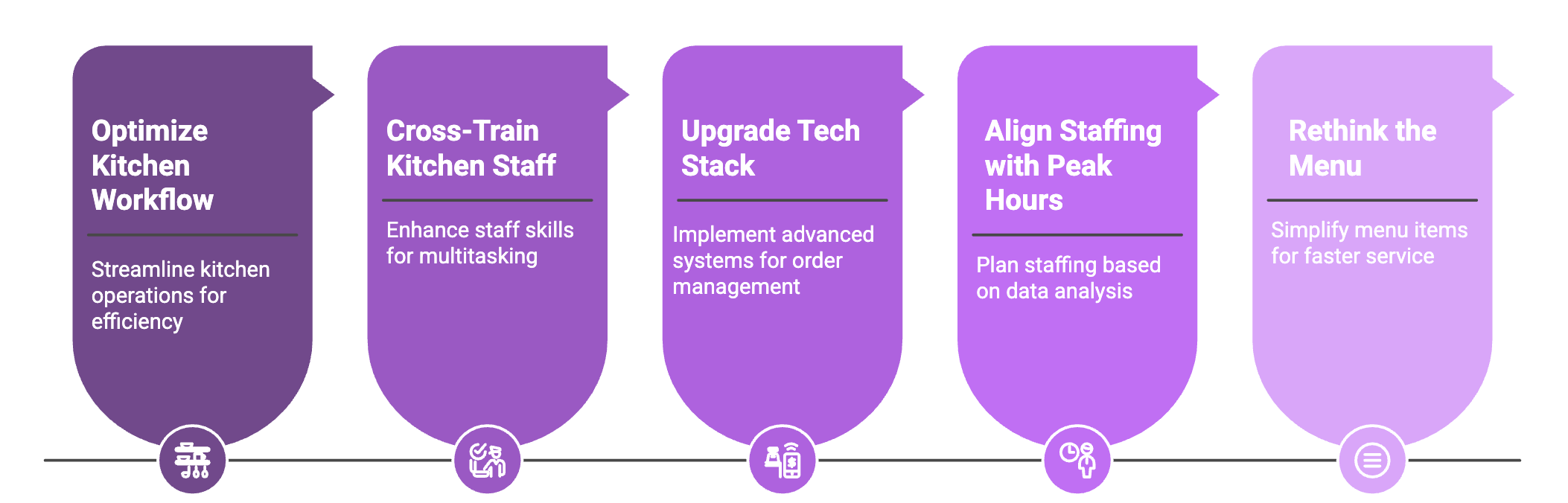
1. Optimize Kitchen Workflow
-
Set up efficient stations
-
Pre-prep common ingredients
-
Use visual kitchen display systems
-
Eliminate bottlenecks in hand-offs and plating
2. Cross-Train Kitchen Staff
Staff who can multitask during rush hours = faster tickets and fewer delays.
3. Upgrade Your Tech Stack
-
POS systems can log order timestamps
-
Kitchen management software syncs item preparation
-
Wait-time displays help manage customer expectations
4. Align Staffing with Peak Hours
Don’t just throw bodies at the problem. Use data to plan:
-
How many staff do you really need?
-
Where are the slowdowns – front-of-house or back?
5. Rethink the Menu
-
Simplify overly complex items
-
Pre-prep during off-hours
-
Offer a “speedy” menu during rush time
Beyond Speed: What Order Cycle Time Reveals
It’s not just about speed—it’s about consistency. If your time is regularly climbing, it could indicate:
-
Equipment issues
-
Training gaps
-
Workflow inefficiencies
-
Menu items that are dragging down service
Track it weekly. Compare it to customer feedback. Use it to improve not just service times, but entire operations.
The Bottom Line
A great restaurant doesn’t need to be the fastest—it needs to be reliably fast enough for its concept. Managing order cycle time helps you strike that perfect balance between speed, quality, and customer happiness.
Because in this business, every minute matters.