Back
Back










Operating Profit Margin
Operating profit margin is the silent judge of your restaurant’s success. While your revenue might look impressive, this metric tells you the truth: how much of that money actually stays with you after paying for everything it takes to run your business.
If you’re not tracking it, you’re flying blind.
What Is Operating Profit Margin?
In simple terms, operating profit margin is the percentage of your total revenue left after covering operating expenses—including food, labor, rent, utilities, marketing, and maintenance—but before interest and taxes.
Formula:
Operating Profit Margin=(Revenue – Operating ExpensesRevenue)×100\text{Operating Profit Margin} = \left( \frac{\text{Revenue – Operating Expenses}}{\text{Revenue}} \right) \times 100Example:
If your monthly revenue is ₹10,00,000 and your operating costs are ₹8,50,000, your operating profit margin is 15%.
This percentage is your financial performance report card.
Why It Matters More Than Revenue Alone
A high revenue doesn’t always mean a healthy business. Consider this:
-
Restaurant A earns ₹7,50,000/month with a 5% margin = ₹37,500 profit
-
Restaurant B earns ₹5,00,000/month with a 12% margin = ₹60,000 profit
In this case, lower sales = higher profits, thanks to tighter control over costs.
What’s a Good Operating Profit Margin?
It depends on your restaurant type:

Margins may seem small, but every single percentage point matters when it comes to long-term sustainability.
What Affects Your Operating Margin?
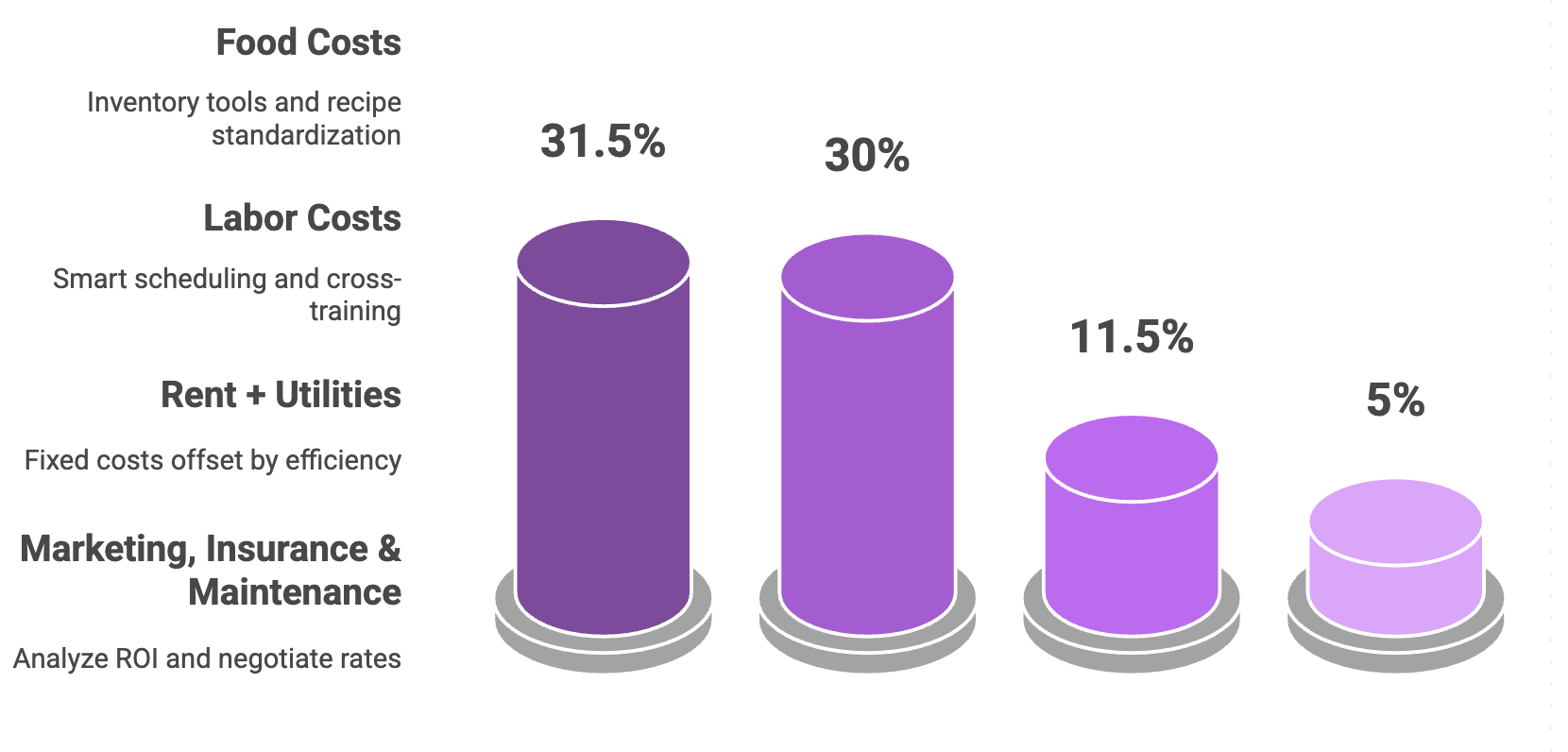
Food Costs
Target 28–35% of revenue. Use inventory tools and recipe standardization to keep waste low and pricing tight.
Labor Costs
Aim for 25–35% of revenue. Overstaffing kills margins. Smart scheduling, cross-training, and monitoring productivity can help.
Rent + Utilities
These fixed costs usually eat up 8–15% of your revenue. If you can’t reduce them, offset with better efficiency elsewhere.
Marketing, Insurance & Maintenance
Every small cost adds up. Analyze ROI on campaigns and negotiate better rates wherever possible.
How to Improve Operating Profit Margin
1. Menu Engineering
Promote high-margin dishes. Rethink low-margin crowd-pleasers. Use POS data to guide menu changes, not just gut feeling.
2. Smarter Labor Management
Use past sales data to build efficient rosters. Avoid overstaffing during slow hours and burnout during peak time.
3. Adopt Technology
-
POS systems reduce billing errors and track what’s selling
-
Inventory software cuts food waste
-
Smart scheduling tools save labor hours
4. Track Your Margins Regularly
-
Monthly: Spot long-term trends
-
Weekly: Check promotion effectiveness
-
Daily (during peak times): Ensure high-volume days are still profitable
Turn Your Margin into a Strategic Tool
Don’t just treat operating profit margin as a number for your accountant. Use it as a decision-making compass:
-
Should you drop a dish or reprice it?
-
Is that marketing campaign worth it?
-
Can you afford a new hire this month?
If the margin says no, trust it.
Final Thought: Margins Make the Business
Revenue is exciting, but operating profit margin is what keeps your restaurant alive, scalable, and eventually, sale-worthy. In an industry with razor-thin profits, keeping even 2–3% more can mean the difference between thriving and barely surviving.
Track it. Understand it. Improve it.