Back
Back










 BACK TO BLOG HOME
Your menu represents the single most powerful profit-driving tool in your restaurant. Moreover, it directly influences every customer interaction, purchase decision, and your bottom line. However, most restaurant owners treat their menu as a simple list of dishes rather than a strategic business weapon.
Today’s most successful restaurants understand that menu engineering transforms ordinary food lists into profit-maximizing sales machines. Furthermore, they leverage data-driven strategies to guide customer choices, increase average ticket sizes, and boost operational efficiency without compromising the dining experience.
What Menu Engineering Really Means
Menu engineering combines data analysis, pricing psychology, and visual design to strategically position your most profitable dishes. Additionally, it guides customer behavior through careful placement, pricing, and presentation of menu items.
The concept originated in the 1980s when Professor Michael Kasavana and Donald Smith revolutionized restaurant profitability. Instead of relying on aesthetics alone, they introduced analytical frameworks that restaurants still use today. Consequently, menu engineering has evolved into a sophisticated discipline that blends behavioral economics with operational efficiency.
You must be interested in reading about: Mise en Place
The Four-Category Framework That Changes Everything
Successful menu engineering starts with categorizing every dish into four distinct groups:
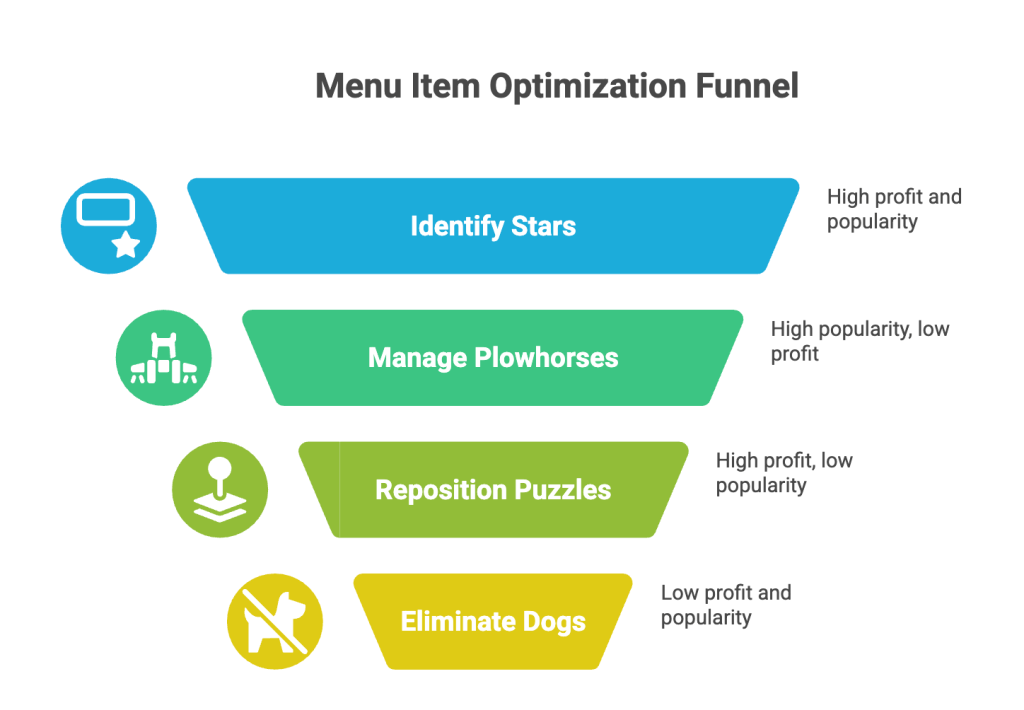
Stars represent your ideal menu items—high profitability combined with high popularity. These dishes should dominate your menu’s prime real estate. For example, Chick-fil-A’s original chicken sandwich exemplifies a perfect star item.
Plowhorses sell frequently but generate lower profit margins. While these items drive traffic, they shouldn’t receive premium positioning. Nevertheless, they serve an important role in your overall menu strategy.
Puzzles offer high profit margins but struggle with popularity. These items require strategic repositioning, better descriptions, or promotional efforts to boost sales. Sometimes, a simple name change transforms a puzzle into a star.
Dogs perform poorly in both popularity and profitability. These menu items typically need elimination or complete reimagining. However, some dogs serve strategic purposes, such as making other items appear more valuable.
Strategic Menu Layout: The Golden Triangle Advantage
Eye-tracking studies reveal that diners follow predictable reading patterns when viewing menus. Specifically, customers’ eyes move in a triangular pattern, starting from the top-right corner, then moving to the top-left, and finally settling in the center.
This “Golden Triangle” represents your menu’s most valuable real estate. Therefore, position your star items and high-margin puzzles within this zone. Additionally, use visual elements like boxes, borders, or subtle highlighting to draw attention to these profitable dishes.
Chili’s masterfully applies this principle by strategically placing their Triple Dipper appetizer in prime menu positions. Consequently, this single item now represents 14% of their total sales, demonstrating the power of strategic placement.
Pricing Psychology That Drives Profits
Menu pricing extends far beyond covering food costs. Instead, it involves understanding customer psychology and creating perceived value. Moreover, strategic pricing can dramatically increase your average ticket size.
Decoy pricing works exceptionally well in restaurant settings. For instance, if you offer a $12 burger, adding a $16 “premium” burger makes your $14 signature burger appear reasonably priced. This psychological principle influences customer choices without feeling manipulative.
Read about: Food Cost Percentage
Anchor pricing establishes a reference point for all other prices. When KFC introduced their $25 Fan Favorites Box, it made their $7 meal deals seem incredibly affordable. Therefore, customers perceive greater value across your entire menu.
Bundle pricing increases average ticket sizes while providing customer value. Popeyes’ success with their $3.99 chicken wraps demonstrates how strategic bundling creates win-win scenarios for restaurants and customers alike.
Visual Design Elements That Sell
Menu design significantly impacts customer behavior and sales performance. Furthermore, every visual element sends psychological signals that influence ordering decisions.
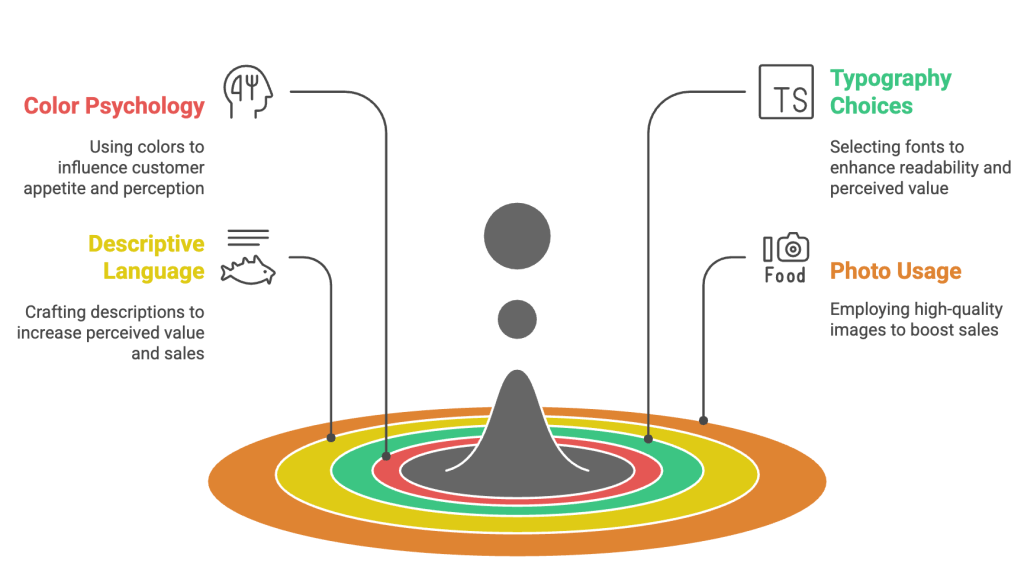
Color psychology plays a crucial role in menu effectiveness. Red stimulates appetite and creates urgency, while green suggests freshness and health. However, avoid overusing these colors, as too much stimulation can overwhelm customers.
Typography choices affect readability and perceived value. Clean, readable fonts convey professionalism, while script fonts suggest premium quality. Nevertheless, always prioritize readability over artistic expression.
Descriptive language increases perceived value and sales. Instead of “Grilled Chicken,” try “Herb-Crusted Free-Range Chicken Breast.” Studies show that descriptive menu items can increase sales by up to 27%.
Photo usage requires careful consideration. While high-quality food photos can boost sales, poor images actually decrease perceived value. Therefore, use professional photography sparingly and only for signature dishes.
Real-World Success Stories
Chick-fil-A’s Testing Strategy demonstrates the power of data-driven menu decisions. Rather than launching new items nationwide, they test in specific markets like Salt Lake City and Jacksonville. This approach minimizes risk while gathering valuable customer feedback before major rollouts.
Taco Bell’s Innovation Balance shows how restaurants can innovate while maintaining brand identity. Their 2025 menu revamp includes bold new items like cheese-shelled tacos, but they’re simultaneously “revamping classics” to maintain customer loyalty.
Popeyes’ Brand Integration exemplifies smart menu expansion. Their biscuit-inspired tortillas for chicken wraps aren’t just new items—they’re uniquely Popeyes creations that competitors cannot easily replicate.
You must read: Chick-fil-A to KFC: Your Go-To Guide for the Latest Fast-Food Menu Updates
The Data-Driven Menu Revolution
Modern restaurants leverage sophisticated analytics to make menu decisions. Instead of relying on intuition, successful operators analyze customer ordering patterns, profitability metrics, and operational efficiency data.
Track which dishes drive repeat visits versus one-time purchases. Additionally, monitor how menu changes affect customer frequency and average spending. This data reveals which items build long-term customer relationships.
Leveraging Customer Data for Menu Success
Smart restaurant owners use customer relationship management systems to understand individual dining preferences. For instance, platforms like Reelo help restaurants track each customer’s order history, favorite dishes, and spending patterns. This granular data transforms menu engineering from guesswork into precision targeting.
When you know that Customer A always orders pasta dishes while Customer B prefers grilled items, you can create targeted menu recommendations. Moreover, this data helps identify which menu items create loyal customers versus one-time visitors. Therefore, restaurants can optimize their menu mix based on actual customer behavior rather than assumptions.
Furthermore, analyze seasonal trends and customer preferences to optimize menu timing. For example, Chick-fil-A’s June launch of Peach Milkshake and Peach Frosted Lemonade capitalizes on summer fruit associations.
Implementation Strategy for You
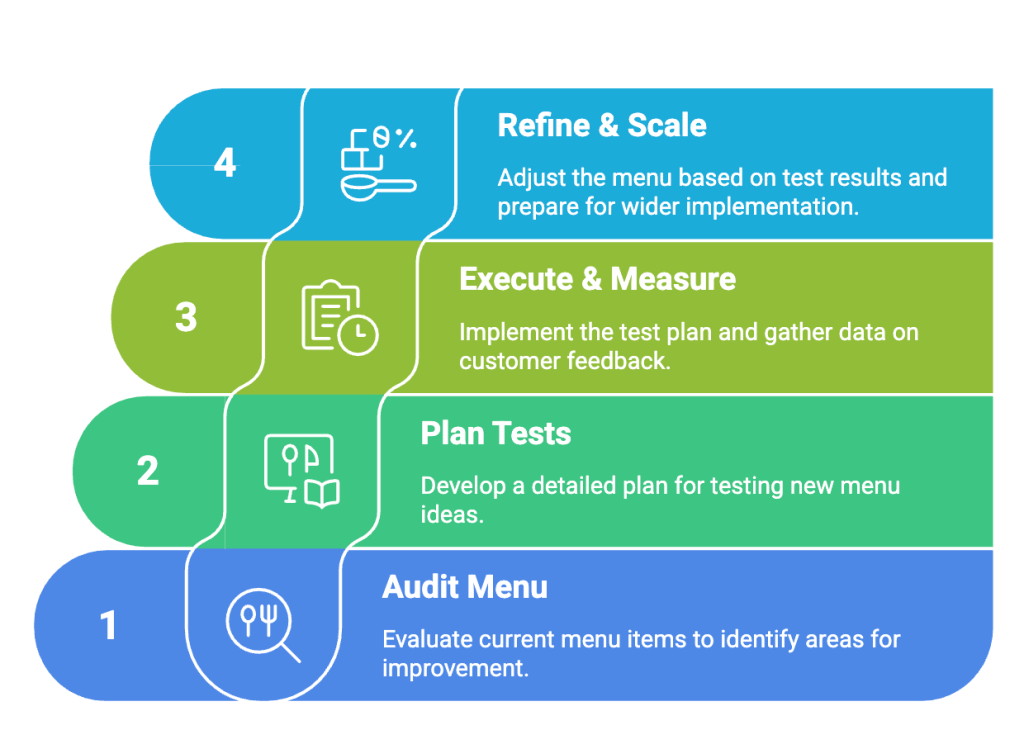
Week 1: Audit Your Current Menu
- Identify your top 5 selling items
- List items that haven’t sold well in 3 months
- Calculate profitability for each menu section
- Survey staff about operational challenges
Week 2: Plan Your Tests
- Choose 1-2 new items based on customer requests
- Select testing periods during slower hours
- Create simple feedback collection methods
- Set success metrics before launching
Week 3: Execute and Measure
- Launch test items with proper staff training
- Gather customer and staff feedback daily
- Track sales data and profitability metrics
- Document what works and what doesn’t
Week 4: Refine and Scale
- Adjust recipes based on feedback
- Decide permanent, seasonal, or discontinuation status
- Plan next testing round
- Update staff training accordingly
Common Menu Engineering Mistakes to Avoid
Many restaurant owners offer too many choices, creating decision paralysis. Research shows that menus with 7-10 items per category perform better than those with 15+ options. Therefore, focus on doing fewer things exceptionally well.
Poor pricing logic confuses customers and reduces perceived value. Avoid random price endings and ensure your pricing structure makes logical sense across categories.
Highlighting low-margin items wastes valuable menu real estate. Instead, use prime positioning for your most profitable dishes while maintaining overall menu balance.
Ignoring staff feedback creates operational inefficiencies. Your kitchen and service teams understand which dishes slow operations or create quality issues. Moreover, they often have valuable insights about customer preferences.
The Continuous Improvement Mindset
Menu engineering isn’t a one-time project but an ongoing process. Successful restaurants regularly analyze performance, test new concepts, and refine existing offerings. Additionally, they stay responsive to changing customer preferences and market trends.
Monitor your menu’s performance monthly and make adjustments quarterly. Furthermore, track seasonal patterns and plan menu changes accordingly. This systematic approach ensures your menu remains fresh, profitable, and aligned with customer expectations.
Your Next Steps
The most successful restaurants treat their menu as a living, breathing marketing tool that evolves with their business and customers. Moreover, they understand that small, strategic changes often produce dramatically better results than complete overhauls.
Start by implementing one menu engineering principle this week. Whether it’s repositioning a high-margin dish, improving item descriptions, or analyzing your current sales data, take action immediately.
Remember, your menu communicates your brand’s story, guides customer choices, and directly impacts your profitability. Therefore, every menu decision should align with your business objectives while enhancing the customer experience.
The restaurant industry’s most profitable operators have already embraced menu engineering. The question isn’t whether you should optimize your menu, it’s whether you’ll lead or follow in your market.
What will your menu say about your restaurant tomorrow?
About The Author